
Getzner Building Base Isolation: Vibration & Noise Control
Getzner Building Base Isolation provides bespoke vibration and noise protection for building foundations using high-performance Sylomer® and Sylodyn® materials. Gitco-sa.com delivers these custom solutions, offering the lowest prices for isolation products across Saudi Arabia.
Description
Getzner Building Base Isolation is an intelligent solution for structurally decoupling buildings from external vibration and noise sources. This is a critical requirement in densely built urban environments, particularly for buildings located near busy transport routes like railway lines, subways, and major roads.
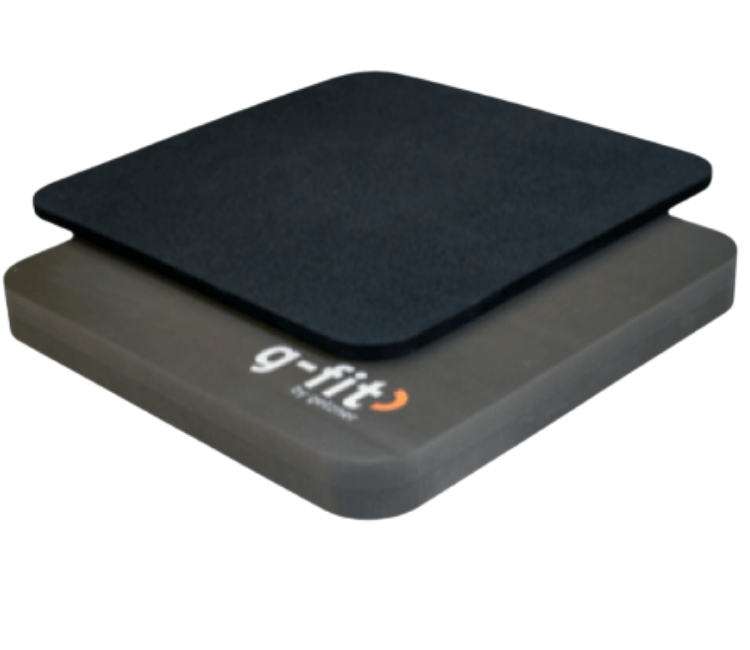
The system utilizes specialized elastic materials Sylomer® (elastomers with spring and damping characteristics) and Sylodyn® (elastomers with pronounced spring characteristics) to form a resilient bearing under the foundation. This decoupling ensures effective shielding against dynamic loads, which in turn protects the building structure, minimizes secondary airborne noise, and significantly improves the quality of life for residents. The materials are durable, maintenance-free, and retain their dynamic properties for decades.
Bespoke Applications and Variations:
Getzner’s approach is based on custom engineering, allowing for a complete range of tailored solutions:
-
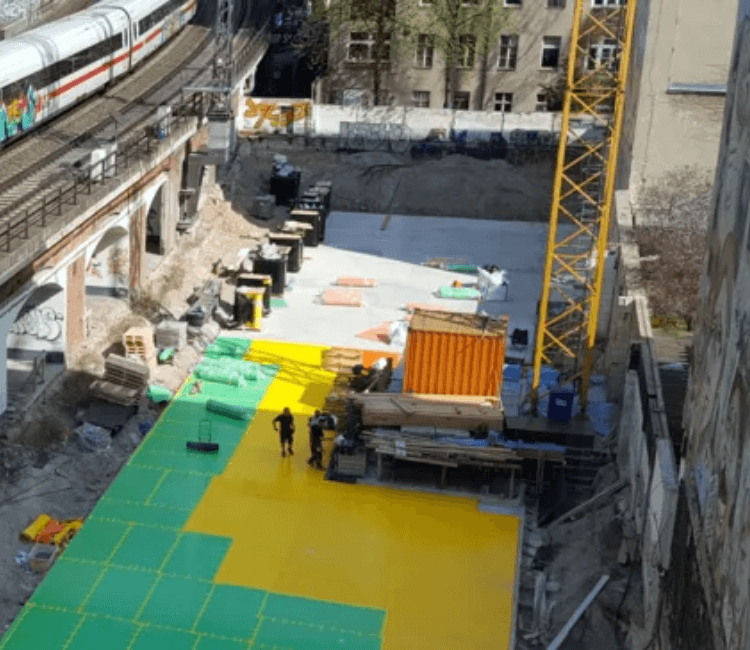
Full-Surface Isolation: For entire base slabs, offering low natural frequencies and easy installation.
-
Linear Isolation: Bearing on strip foundations for lower material costs.
-
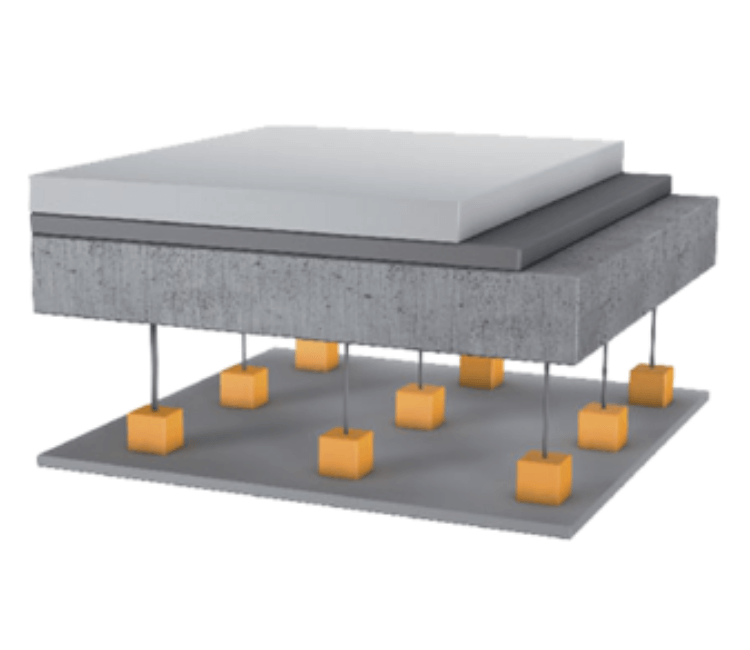
Point-Support Isolation: Designed for heavy load zones on single and pile foundations.
-
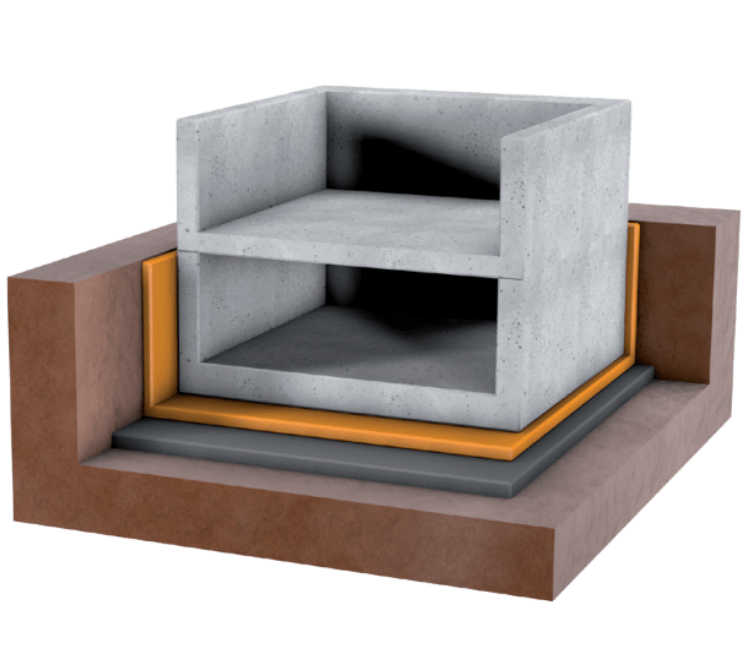
Sidewall Isolation: Decoupling the side walls from the ground, often used in conjunction with other bearing types.
-
Isolation within the Building: Decoupling between different floors to prevent vibration transfer internally.
Gitco-sa.com offers expert consultation and implementation for these complex solutions. We ensure our product prices are the Lowest for isolation products, providing budget-friendly high-performance solutions in Dammam, Al-Khobar, Al Jubail, Riyadh, Jeddah, and across Saudi Arabia.
Key Applications of Building Base Isolation:
-
Buildings Near Transport Corridors: Residential, commercial, and mixed-use properties located adjacent to high-vibration sources (e.g., train stations, highways, metro tunnels).
-
Concert Halls & Recording Studios: Protecting acoustically sensitive structures from external ground-borne noise.
-
Hospitals and Laboratories: Ensuring vibration-free environments required for sensitive equipment and patient recovery.
-
High-Value Property Development: Increasing the market value of properties by guaranteeing excellent interior acoustic comfort and minimizing structural wear.
Know more about Building Base Isolation:
1. Fundamentals of Base Isolation
- What is Getzner Building Base Isolation?
It is a method of structurally decoupling a building’s foundation from the surrounding ground using high-performance elastic materials to minimize the transmission of vibrations and noise into the structure. - Why is this type of isolation necessary in modern construction?
It’s crucial in urban areas where buildings are constructed near major sources of vibration, such as railway lines, highways, metros, or large machinery, to ensure a high quality of life for residents and protect sensitive equipment. - What is the primary material Getzner uses for base isolation?
Getzner utilizes proprietary polyurethane elastomers called Sylomer® and Sylodyn®, which have excellent spring and damping characteristics and are known for their long-term stability. - What is the difference between Sylomer® and Sylodyn® in this context?
Sylomer® is a mixed-cell elastomer with superior damping properties, suitable for a wide range of loads. Sylodyn® is a closed-cell elastomer with improved dynamic properties and a low creep tendency, often used for applications requiring a specific, very low natural frequency. - What types of negative effects does base isolation eliminate?
It eliminates or significantly reduces the negative impact of structure-borne vibrations and oscillations and the resulting secondary airborne noise within the building.
2. Engineering & Performance
- How does the material isolate vibrations?
The elastic material acts as a mass-spring system. The building’s mass rests on the elastic bearing (the spring), which is designed to have a natural frequency ($\mathrm{f}_0$) much lower than the excitation frequency (the vibration source), thus isolating the building. - What is the target natural frequency for base isolation?
The goal is to achieve a very low natural frequency for the entire building system, often in the range of 7 to 11 Hz (depending on the material type, thickness, and load), to effectively isolate low-frequency external vibrations. - What does a feasibility study from Getzner entail?
A feasibility study is a crucial first step where Getzner’s experts analyze the specific site’s vibration profile, calculate the required spring constant, and recommend the most cost-effective and economical Sylomer® or Sylodyn® type. - Are the materials durable and maintenance-free?
Yes, the materials are engineered for long-term stability, maintaining their elastic properties for decades (often over 50 years) and requiring no maintenance once installed. - Can the material withstand high static loads?
Yes, the materials are highly resilient and can withstand substantial static loads. Sylomer® can handle static loads up to 1.2 MPa (N/mm$^2$) and Sylodyn® HRB HS up to 12.0 MPa for high-load zones.
3. Types of Installation
- What are the common methods of building base isolation?
Base isolation can be executed in three main ways: full-surface isolation, linear isolation (on strip foundations), and point-support isolation (on single or pile foundations). - What is Full-Surface Isolation?
The elastic material is laid out under the entire area of the foundation slab. This method is easy to shape and achieves lower natural frequencies with relatively little subsoil preparation. - What is Linear or Strip Isolation?
The material is applied in continuous strips, typically under the load-bearing walls or strip foundations. This method can achieve very low natural frequencies while being more cost-effective in terms of material usage. - When is Point-Support Isolation used?
This method uses individual elastic bearings placed under columns or pile foundations. It is used for heavy-load zones or when isolating buildings on single or pile foundations. - Can this technology be used for side wall isolation?
Yes, side wall isolation is possible to decouple the sides of the structure from the ground, which is particularly suitable for shielding against vibrations in areas with high groundwater levels.
4. Benefits and Standards
- How does base isolation impact property value?
By providing superior living and working comfort through effective vibration and noise shielding, base isolation significantly increases the value of the property. - Does the isolation material contribute to the building’s fire resistance?
The Sylomer® and Sylodyn® products themselves do not contribute to the structural element’s fire resistance, so they must be protected from fire exposure by the concrete structure or joint filling materials to achieve the required fire rating (FRL). - Are these materials resistant to environmental factors?
Yes, Sylomer® is hydrolysis stable, and both materials are resistant to diluted alkaline, acids, oils, and grease commonly found in construction. Sylodyn®’s closed-cell structure makes it water-resistant. - Does Getzner provide support for obtaining sustainability certifications?
Yes, the materials have an Environmental Product Declaration (EPD), which provides the necessary data foundation for achieving sustainable building certifications like DGNB, LEED, and BREEAM.
Brand
Getzner



Reviews
There are no reviews yet.